Dover
The situation
Dover worked — once you were in. A hiring platform for startups that don't have time to hire well: the engine sources candidates, the Slack and email integrations carry the follow-up, and founders get a candidate experience they'd never have the bandwidth to run themselves. In hindsight, one of the last projects of the pre-AI era — every screen and component made by hand.
But there was no real design system, and the setup asked a lot. I joined alongside Dover's founding designer; the UI had grown the way the product had — piece by piece, good enough to get this far, but each new surface was harder to build than the last. The engine itself was strong — real intelligence, automation, deep integrations — it was the configuration around it that asked too much of new users.
Building the system, reworking the flows
With no system, I did both at once. A handmade design system — atoms and molecules, unified type and color, components built hand-in-hand with front-end so each surface shipped cheaper than the last — and, using it, a rework of the flows that asked the most of users. Three rules held it together: consistent enough to self-start, accessible enough that a setting explains itself, reusable enough to grow.
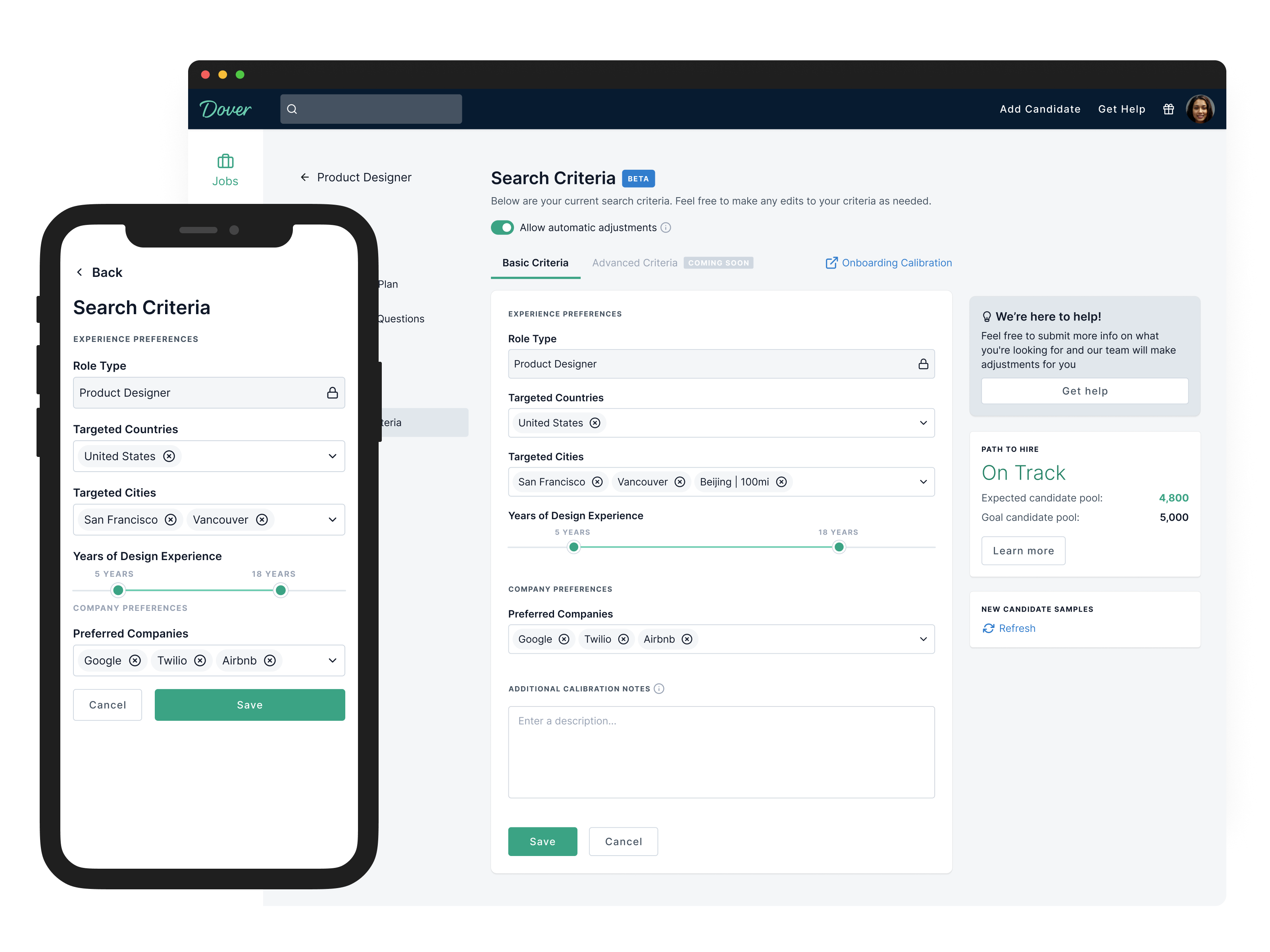
The engine got windows. Search criteria became a page users can read and edit — what Dover believes you want, in plain language, with a path-to-hire signal showing whether the current criteria can fill the role. The black box a customer once described — "I don't know what kind of candidate I'm getting" — became legible and steerable.
Existing features became editable in place. Screener questions had been generated and fixed; now users add, edit, and reorder them inside the structure that already existed — customization without a rebuild.
The deeper problem: nobody could self-onboard
The pattern those fixes revealed was the door. Onboarding needed a meeting with customer support; integrations needed another. Painful for customers, heavier still for the CS team — and structurally a bottleneck: nobody could just sign up and try Dover, so growth leaned on referrals and sales. A product good enough to sell itself wasn't being allowed to.
It had been built for a blur of users at once — HR teams, founders, and Dover's own internal staff — and that blur is what kept the settings complex and self-serve perpetually deprioritized. The team had the instinct that self-serve mattered; what nobody had was bandwidth. So I made the case. The PM and founding designer backed it, and opening the door became a real project — within real constraints of few reachable users and carefully spent engineering time.
A door that opens itself
A mobile-responsive onboarding a founder can finish alone. Customizable at every stage, speaking the same design language as the app — so completing setup already teaches the product, and trying Dover stops requiring a sales call.
From sales-led to try-it-yourself. Customers responded most to the surfaces they could finally steer, the support load dropped, and the system foundation made the design–engineering pipeline faster for everything after. Dover's front door today is a free ATS anyone can sign up for and start using in minutes — the open door became the strategy.
The recruiter marketplace they've since added reads, to me, as the same lesson extended: some founders don't need a smarter tool — they need a person.
Work from 2022, while at Dover. This records the thinking, not the current state.